
English| EUR
Suggested for you
More currencies
Choose a language
A cabled route above Banff is not a hiking trail with handrails, and it is not free-climbing either. It sits in a regulated middle ground with its own conditions of entry. This via ferrata rules guide sets out what Mt Norquay asks of every climber before the harness goes on.
Quick answer
Every route on Mt Norquay is guided-only, with lift access included in the 199 CAD entry-level tour. Climbing operates daily from 09:00 to 17:00, and no self-guided access is permitted on any section. Guides carry final authority over turnarounds, weather calls and group pace, and lightning risk can close a route mid-season without notice.
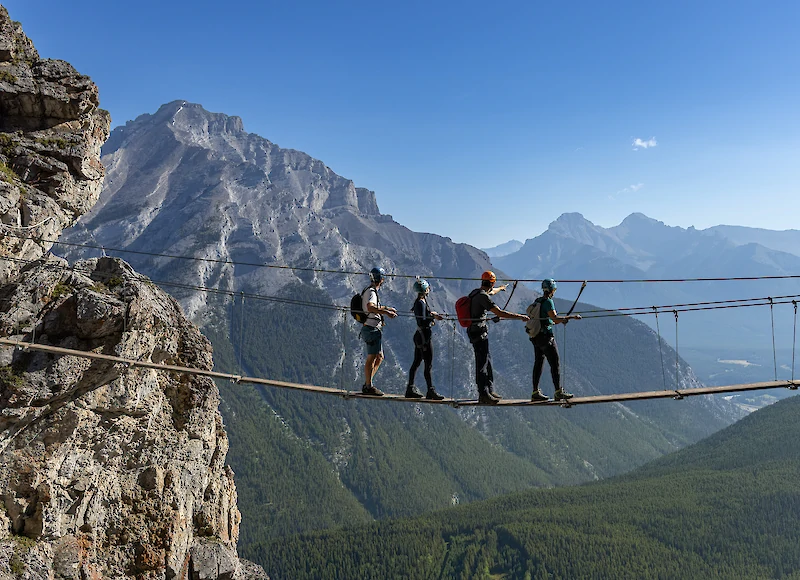
The steel cable bolted into Mt Norquay's quartzite is a wartime inheritance. Italian troops strung the first via ferrate across the Dolomites to move soldiers over terrain that would otherwise demand rope teams, and the engineering barely changed on its way to Alberta: a continuous cable, anchored every few metres, that a climber clips into and never leaves. That single detail governs almost everything else. Via ferrata rules in the Canadian Rockies exist because the system only protects a person who stays attached to it. What a first-timer is actually dealing with is a supervised system rather than a personal decision. Mt Norquay operates its routes as guided climbing regulations, not as open terrain — there is no gate to walk through unaccompanied, and the harness, lanyards, helmet and via ferrata set are issued and fitted at the base, not brought from home. Guides handle the anchor transitions, watch clipping technique at every stanchion, and hold the authority to turn a group around. That authority is not ceremonial. Above the treeline on the North American Wall, an approaching cell changes the calculation quickly, and the guide's call ends the discussion. Context explains the rest. The routes climb through the Norquay ski area at elevations where afternoon convection builds through July and August, and where the rock stays cold and greasy well into June. Suspension bridge crossings, exposed ladder rungs and long traverses reward a steady pace and punish hesitation more than they punish weak arms. Balance, a head for heights and the willingness to keep moving matter considerably more than upper-body strength. Vertigo is the single most common reason a climber stops early, and it is worth an honest self-assessment before booking rather than at the second bridge. The practical use of this via ferrata rules guide is simple: treat the mountain's conditions as fixed and plan around them. Confirm eligibility details and physical requirements before you book, check the day's forecast the night before, and arrive dressed for a temperature swing rather than for the parking lot. Mountain conduct expectations, gear checklists and season-by-season timing are set out in the sections below, and the booking pages hold current availability for each route.
“The cable only protects a climber who stays attached to it — every other rule on the mountain follows from that one.”
On a via ferrata, the cable system only protects you when every person on it follows the same protocol, and a single unclipped moment or crowded anchor affects the whole rope team. Etiquette on the Mount Norquay routes is mostly about spacing, clear communication, and respecting your guide's instructions above the ladder rungs and suspension bridges.
Via ferrata sets firm limits on who can clip in and what they wear, so work through these in order from the week you book to the morning you climb.
The best arrival window for your via ferrata experience is 09:00–11:00. Arriving during this period helps guests avoid peak afternoon heat and reduces exposure to potential thunderstorm risks that are common at high elevations.
Warm days, frequent afternoon thunderstorms
Cooler, stable air with lower humidity
—;Early arrival allows for cooler, calmer mountain conditions throughout your climb.
Verdict: For the most consistent conditions, plan your arrival between 09:00 and 11:00 during the months of June through September.
The Via Ferrata at Mt Norquay operates daily throughout the season to accommodate visitors.
Everything you need to know about via ferrata rules
Adhering to via ferrata rules ensures safety while navigating the cable-assisted climbing routes. Climbers must remain clipped into the safety cable at all times and follow guide instructions precisely. These safety protocols are designed to manage the risks inherent in high-altitude terrain. Familiarizing yourself with these standard operating procedures is a vital step for every participant.
All participants must meet established weight requirements to ensure the integrity of the safety systems. While specific thresholds can vary by route, these constraints are non-negotiable for operator insurance and safety standards. Please confirm your eligibility regarding these physical prerequisites during your booking process.
No prior mountaineering experience is required for many entry-level guided tours. The system utilizes fixed anchors and steel cables, allowing beginners to enjoy mountain vistas safely. Your guide will provide a thorough orientation on the equipment and the necessary via ferrata rules before departure.
Following established arrival guidelines is essential to maintain the schedule of your Banff mountain adventure. Arriving during the suggested window allows for proper gear fitting and safety briefings. Failure to arrive on time may impact your ability to join the scheduled departure.
Most tours have a minimum age requirement to ensure participants can manage the physical demands and focus required on the cliffside. Guardians must be present for younger climbers, and specific age rules vary by tour provider. Check the official requirements to ensure your group meets all criteria before finalizing your plans.
For safety and liability reasons, participants are generally required to use certified equipment provided by the operator. Personal climbing gear may not meet the specific certification standards required for these commercial operations. Using provided gear ensures that all safety protocols remain consistent throughout the outing.
In the event of inclement weather such as lightning or high winds, operators may modify or cancel tours to prioritize guest safety. These safety-driven via ferrata rules are strictly enforced by guides who monitor real-time weather reports. Always check your booking status if you observe threatening sky conditions in the mountains.