English| EUR
Suggested for you
More currencies
Choose a language
Every via ferrata climb above Banff begins on the same limestone flank of Mount Norquay, yet the experience splits sharply depending on how far along the cliff a group travels. Some parties turn back after a short traverse; others cross a suspension bridge and continue toward the summit ridge. This banff via ferrata routes guide sets out what separates one option from the next.
Quick answer
Guided route options on Mount Norquay range from short introductory traverses of a couple of hours to full-day ascents reaching the summit ridge, all accessed from 2 Norquay Road. The mountain itself charges no entrance fee, though tour fees apply for via ferrata access. Routes run daily between 08:30 and 18:30 in summer, weather permitting.
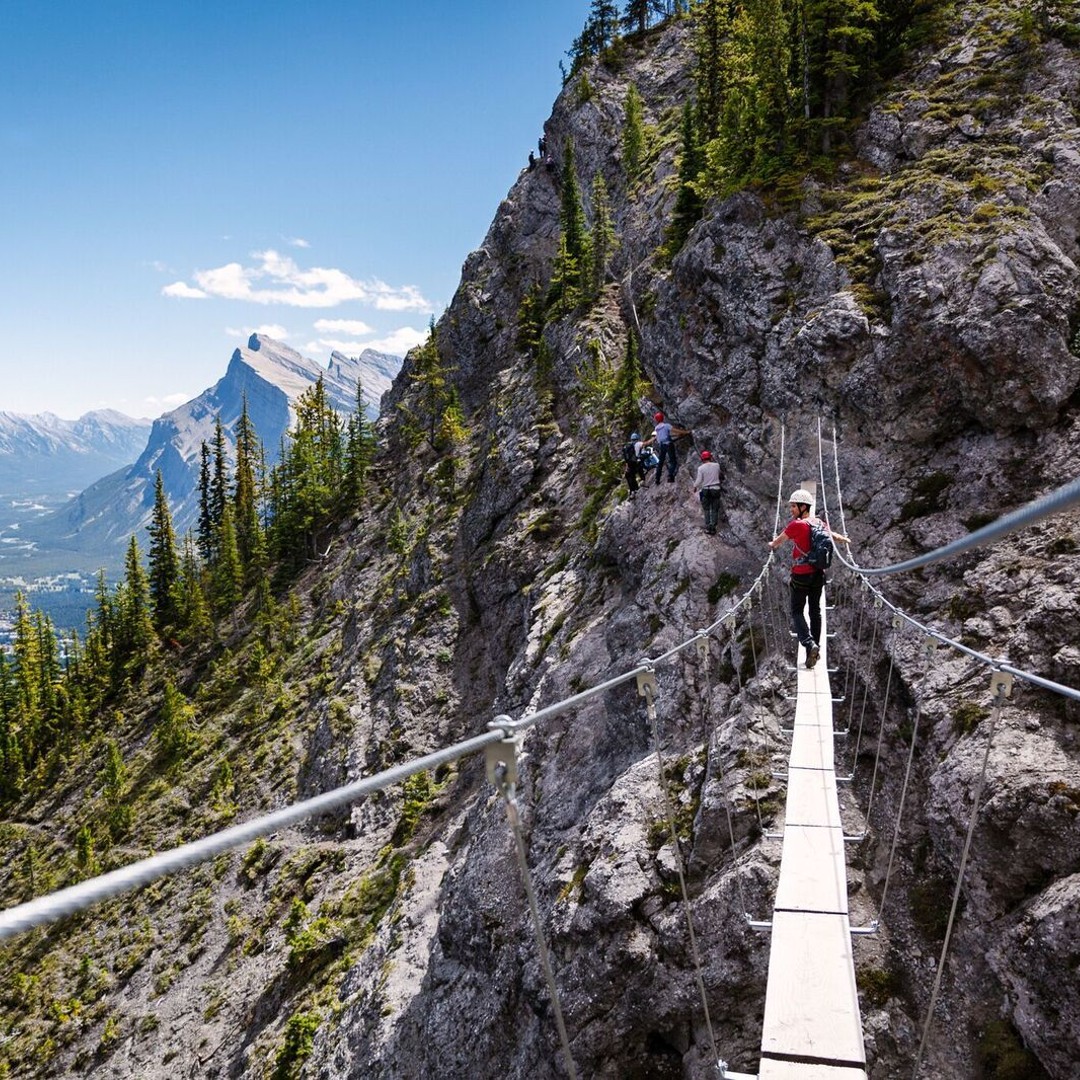
The iron rungs bolted into Mount Norquay's east face follow a cliff band that was once crossed only by scramblers with rope and nerve. Today a continuous steel cable runs the length of that limestone, and climbers clip into it with a harness and two lanyards. The system is Italian in origin — via ferrata means "iron road" — and it converts terrain that would otherwise demand years of technique into something a fit beginner can attempt with a certified guide. The banff via ferrata routes on this mountain sit roughly 1,600 metres above the town, with the Bow Valley, Cascade Mountain and the Vermilion Lakes laid out below. What separates the options is distance along the cliff and the point at which a group descends. Shorter mountain climbing tours cover the lower rungs, an exposed traverse and a first taste of vertical ladder work before dropping back toward the North American chairlift. Longer itineraries continue past that decision point, adding a cable-stayed suspension bridge strung across a gully, a series of steeper pitches, and — on the fullest option — a push toward the summit ridge and a hike out along the mountain's shoulder. Exposure increases with each stage rather than difficulty in a technical sense; the rungs stay the same size, but the drop beneath them grows. All options are guided. Nobody clips into the cable unaccompanied, which means the choice is made at booking rather than on the rock, and group size is capped. Harness, helmet, lanyards and gloves come from the operator. Climbers supply sturdy footwear and layers, since the face holds shade in the morning and wind at the ridge. Age and height minimums apply to the longer Norquay climbing routes, and the chairlift ride to the trailhead is part of the package. Choosing between the Banff via ferrata routes comes down to honest arithmetic about stamina and comfort with height rather than climbing résumé. Those unsure of their tolerance for exposure are better served by the shorter traverse, which reaches genuine cliff terrain within the first half hour and gives an early, informative answer. Those confident on ladders and wanting the ridge should build the day around an early departure — the first window after 08:30 brings cooler rock and thinner crowds. Booking pages carry current departure times, minimum ages and durations for each option.
“Exposure increases with each stage rather than difficulty in a technical sense; the rungs stay the same size, but the drop beneath them grows.”
This plan suits first-time via ferrata participants booked on a guided route at Mt Norquay, and runs roughly six to seven hours door to door from the Cascade Lodge base to the return descent. It assumes the early arrival window of 08:30–10:00, when conditions are cooler and the base area is quieter.
Reach 2 Norquay Road and park near Cascade Lodge, allowing 15 minutes to find the guide meeting point and use the washrooms before check-in closes.
Present your booking at the via ferrata desk inside Cascade Lodge and complete the liability waiver. Budget 20 minutes if several groups are checking in at once.
Guides issue a climbing harness, helmet, gloves and lanyard system, then adjust the fit. Wear layers you can shed, as fitting over a bulky jacket slows the process.
The chairlift carries the group toward the ridge access point in about 10 minutes. Keep gloves clipped rather than loose on the lift.
A short hike leads to the start of the cable, where guides demonstrate clipping technique on a practice section. Expect 30 minutes before the first rungs.
The graded sections combine iron rungs, suspension bridges and ledge traverses, with the group moving at the pace of its slowest member. Drink water at each rest ledge.
Walk the descent trail or ride the chairlift back down, then hand in harness and helmet at the lodge. Allow 20 minutes for gear return before leaving.
Use the lodge deck to eat and rehydrate while your legs recover. The mountain itself is free to access, so there is no rush to clear the area.
The via ferrata season typically runs from mid-June through early October, with late summer providing the most stable conditions. Planning your arrival for the early morning window ensures optimal temperatures and lower volume on the routes.
Cool, potential for lingering snow
Trails are quiet as high-alpine routes open.
Warmest, 15°C to 25°C
Longer days allow for flexible scheduling.
Cooler, 5°C to 15°C
Clear air and stable conditions prevail.
—
The best arrival window is 08:30–10:00 to beat the mid-day peak crowd.
Verdict: For the quietest experience, visit on a weekday during September, arriving at 08:30.
Via ferrata routes on Mount Norquay are guided-only, so preparation runs from securing a spot weeks ahead to final gear checks at the base.
The Via Ferrata routes at Mount Norquay operate daily during the summer season. These hours apply to all accessible climbing routes.
Operations are seasonal and subject to weather conditions. Please check the official Banff Norquay website for updates regarding the start and end dates of the season.
Access to the mountain itself is free, though participation in via ferrata routes requires a paid tour booking. Tour fees are determined by the specific route selected and guide requirements.
Verdict: While mountain access is 0 CAD, visitors must purchase a guided tour to access the via ferrata routes, with final costs varying based on the route selected.
Everything you need to know about banff via ferrata routes
There are several banff via ferrata routes designed for different experience levels, ranging from shorter introductory climbs to more challenging, high-exposure mountaineering paths. Each path utilizes a system of steel cables and ladders bolted into the limestone cliffs to assist your progress. Visitors should consult official guides to determine which option aligns with their physical fitness and comfort with heights. These guided adventures provide access to vertical terrain that would otherwise require advanced technical rock climbing skills. Safety equipment, including a harness, energy-absorbing lanyard, and helmet, is provided as part of your guided experience on all banff via ferrata routes. Participants are strictly required to use this gear throughout the duration of the climb to ensure their protection while navigating the cliffside. Local guides also provide mandatory training on how to properly clip into the cable system before you begin. It is highly recommended to secure a spot for your preferred banff via ferrata routes ahead of time through the official website. Tours frequently sell out, especially during the peak summer months, due to limited group sizes and guide availability. While specific age requirements vary by route, some paths are designed to accommodate younger climbers who meet the minimum weight and height thresholds. Families should review the specific physical prerequisites for each excursion to ensure a safe experience for all children. Parents or guardians must accompany minors throughout the entire activity. Early morning is considered the best arrival window, specifically between 08:30 and 10:00, to take advantage of cooler temperatures and avoid peak crowds. Starting your journey early ensures a more comfortable experience on the rock face as you complete your selected mountain route. There is an entrance fee of 0 CAD to access the mountain itself, though standard tour fees apply for accessing the via ferrata equipment and guided services.